
Traceable vs Defensible: the Governance Gap in the AI Agent Security Stack
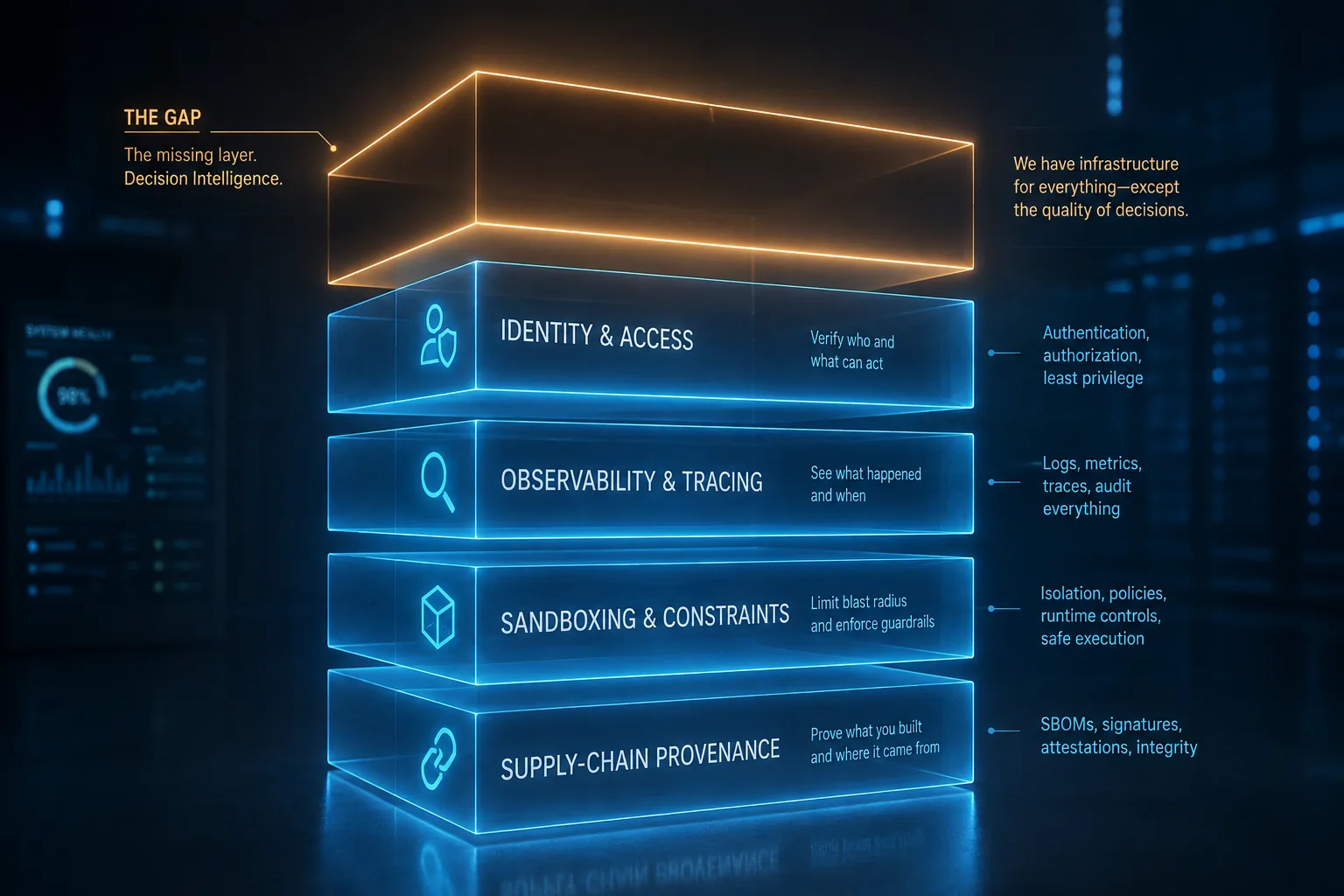
The 2026 AI agent security ecosystem comprises complementary layers: workload identity systems answer which agent is calling; agent harnesses record what the agent did with typed inputs and outputs; policy sandboxes enforce what an agent may do at runtime; and supply-chain provenance tools establish where artifacts came from. These layers deliver observability, traceability and provenance. None of them captures why a decision was defensible: the arguments for and against, the alternatives considered, the evidence relied on, the human oversight exercised, and tamper-evident proof the record was not altered. That is a separate layer — auditability and governance — where AIAgentree operates. The traceability layers are producers for the defensibility layer, not competitors: their identity assertions and execution traces are inputs to decision records. Published ecosystem materials name logs as a scope area while defining no common trace schema, no tamper-evidence requirement, and no conformance mechanism, which is precisely the space a decision-record layer fills. Under regimes like the EU AI Act, NIST AI RMF and ISO/IEC 42001, the artifact auditors request is the defensible decision record.
The agent-security stack answers four questions brilliantly: who called, what happened, what is allowed, where artifacts came from. Auditors ask a fifth: why was this decision justified — and can you prove the record?
- •Identity, harness, sandbox, provenance — each layer makes agents more traceable. All are necessary. None is a decision record.
- •Five words, five layers — observability, traceability, provenance, auditability, governance. The stack covers the first three; we are built for the last two.
- •Producers, not competitors — their traces are our inputs. An identity assertion drops into a decision record's attribution; a harness trace feeds its evidence.
- •The regulatory pull — EU AI Act, NIST AI RMF and ISO/IEC 42001 all converge on the same artifact: a record that justifies the decision, not one that replays it.
Traceability tells you what an agent did. This cluster is about the next step: records that stand up — under the EU AI Act, NIST AI RMF and ISO/IEC 42001.
- 1.Defensible AI Decisions: The Complete Guide to Records an Auditor Can Act On
- 2.They Made Agents Traceable. We Make Their Decisions Defensible.You are here
- 3.The Decision Record: the PDF an Auditor Actually Opens
- 4.Inside the Signed Decision Packet (the JSON)
- 5.Inside an EU AI Act Evidence Package (Folder by Folder)
- 6.Human Oversight You Can Prove (Because Machines Can't Hold the Permission)
- 7.Article 86: What Affected Persons Can Demand From Your AI
- 8.From First Trace to Evidence Package: an EU AI Act Flow Walk-Through
- 9.A NIST AI RMF Self-Assessment You Can Actually Finish
- 10.ISO/IEC 42001 Readiness: 38 Controls, One Honest Score
- 11.Agent-Native Onboarding: Tracing in 10 Lines (and Agents Can Sign Themselves Up)
Ask the 2026 agent-security stack about an AI decision and it answers with impressive precision: which workload called, what the agent did, which actions policy allowed, where every artifact came from.
Then an auditor asks the only question that was ever going to be asked in a hearing: "Why was this decision justified?"
Silence. Not because the stack is bad — because that was never its question.
The Stack That Emerged in 2026
Credit where due: the agent-security ecosystem that consolidated through 2026 — including a major NVIDIA-led open-source coalition announced in July — is genuinely good engineering, and its layers compose into something coherent:
| Layer | Question it answers | How |
|---|---|---|
| Identity | Who is calling? | Cryptographic workload identity: short-lived certificates, delegation chains that record on-whose-behalf |
| Harness | What did the agent do? | Typed inputs and outputs, code-as-action, explicit state — execution recorded as inspectable structure |
| Sandbox | What may it do? | Policy-enforced runtime boundaries: filesystem, network and process rules producing allow/deny streams |
| Provenance | Where did artifacts come from? | Signed dependencies, build attestations, safe model serialization |
If you deploy agents, you want this stack — genuinely. Identity keeps credentials honest, harnesses make behavior inspectable, sandboxes contain failure, provenance keeps the supply chain clean. Our claim is not that any of it is wrong. It is that the stack, complete, still cannot produce the artifact an audit requests.
Five Words That Get Used Interchangeably (and Shouldn't)
The cleanest way to see the gap is vocabulary. Five terms circulate in this space as if they were synonyms. They are five different questions:
- •Observability — what is the system doing right now? Dashboards, metrics, live traces. Covered — this is the harness and monitoring layer at work. (Primer: What Is AI Agent Observability?)
- •Traceability — can I reconstruct the sequence afterwards? Covered — execution traces, interchange formats, session records.
- •Provenance — where did this artifact come from? Covered — signatures, attestations, SBOMs.
- •Auditability — can an independent reviewer examine the evidence and trust it? Partially covered at best: reviewable logs exist, but integrity guarantees and reviewer-shaped artifacts are not the stack's concern.
- •Governance — what was allowed, who approved, who is accountable? Not covered. No layer in the stack records justification, approval, or accountability as first-class objects.
The stack covers the first three comprehensively, the fourth partially, the fifth not at all. AIAgentree is a four-and-five product. That is a checkable claim, not a slogan — read the published scope of any of these projects and look for the decision record. There is also a fourth audience hiding in this taxonomy: tooling in layers one to three serves the developer and the security operator. The auditor — the independent reviewer with no login to your systems — is the person nobody upstream builds for, and the person the Decision Record is built for.
What a Perfect Trace Still Cannot Say
Grant the stack everything: identity verified, every step recorded with typed I/O, every action inside policy, every artifact attested. Take that maximal trace into an EU AI Act audit — the flow we walk elsewhere — and watch which questions it still cannot answer:
- ✗What was the reasoning? The trace shows the model was called and what came back — not the arguments for and against, weighed and recorded. Interestingly, the ecosystem's own materials concede this: execution traces are observational evidence, not a faithful account of reasoning.
- ✗What were the alternatives? Paths not taken leave no execution to trace. Only a deliberate deliberation record captures the option that was rejected and why.
- ✗Was the oversight human? An approval event in a log could have been written by any process with write access. Proving a person decided requires the permission structure to make machine approval impossible — the structural argument.
- ✗Is the record intact? Append-only is not tamper-proof. Without hash chains, signatures, and offline verification, the trail's integrity rests on trusting the operator's storage.
- ✗Can precedent be cited? A trace is one run. "How did we decide similar cases?" needs decisions stored as retrievable, bounded records — which is what makes the archive an asset rather than a liability.
And here is the confirming detail from the ecosystem's own published materials: logs are named as a scope area, yet no common trace schema, no tamper-evidence requirement, and no conformance mechanism are defined anywhere in the published scope. That is not a criticism — it is a boundary marker. The coalition standardized the plumbing and left the record undefined. The record is the product.
Producers, Not Competitors
So how do the layers relate? Not as rivals — as a supply chain. Everything the traceability stack emits is input to the defensibility layer:
| They produce | We consume it as |
|---|---|
| An identity layer's workload assertion — which agent, on whose behalf | The attribution on a decision record: who decided, under whose authority |
| A harness's execution trace — steps, tool calls, typed results | Evidence references behind the deliberation: the record cites the run, it doesn't replay it |
| A sandbox's policy verdicts — allowed, denied, routed | Policy-evaluation events on the trail: proof the boundaries were active when the decision was made |
| Provenance attestations — what code and model ran | Context for technical documentation: which artifacts stood behind the decision |
This is why "which harness should we bet on?" is a question we never have to answer. Instrument with whatever wins — any harness, any framework, or your own loop. The SDK captures the decision alongside it in ten lines, and better traceability upstream makes the records downstream richer. The stack's success is our tailwind. For teams comparing us against observability tooling head-on, the honest comparison is here — the summary is that it is the wrong comparison.
"Won't the Stack Just Add a Decision Layer?"
The strongest objection, and it deserves its real answer rather than a dismissal. Some harness will eventually ship something called a decision log. But watch what the artifact has to become to matter in an audit: a normative record — claims, counter-claims, weights, alternatives, human approvals — signed, tamper-evident, exportable as a document a court accepts, mapped to EU AI Act articles, NIST AI RMF subcategories and ISO/IEC 42001 controls, with precedent retrieval over the accumulated archive.
That is not a feature on a tracing pipeline; it is a different data model with a different consumer. Execution tooling is built for engineers debugging runs. Decision records are built for auditors, regulators and affected persons — people with no login, no context, and a legal question. Serving the second audience from the first architecture is how you get logs with extra columns: more complete, and still unable to say why.
Diagnostic question: take your best current trace of a consequential agent decision and hand it, unaccompanied, to someone outside engineering. Can they tell you what was decided and why it was justified? If they cannot, you have traceability. You do not yet have defensibility.
The Position, In One Paragraph
The agent-security stack made agents traceable, and the industry is better for it. Traceability answers who called, what happened, what was allowed, where artifacts came from. Defensibility answers the question that follows every consequential decision: why was this justified, who stood behind it, and can you prove the record? Those answers live in a different artifact — the decision record — consumed by a different audience, under three governance frameworks that all converge on it. The layers that make agents traceable are our producers; their output is our input. They made agents traceable. We make their decisions defensible.
Sources & Further Reading
- •NVIDIA — Open Secure AI Alliance announcement — the coalition's own published scope (July 2026)
- •SPIFFE / SPIRE — the open-source workload-identity layer
- •A2A protocol — agent discovery — the standard well-known agent-card path
- •Regulation (EU) 2024/1689 (EU AI Act) — the regime that asks the fifth question — EUR-Lex (2024)
Frequently Asked Questions
What is the difference between traceable and defensible AI decisions?
Traceability means you can reconstruct what an agent did — the calls, steps, and outputs, verified by identity and recorded by a harness. Defensibility means you can justify the decision to an independent reviewer: the arguments for and against, the alternatives considered, the evidence cited, the human oversight exercised — in a tamper-evident, signed record. Traceability is reconstruction; defensibility is justification plus proof of integrity.
What gap exists in the 2026 AI agent security stack?
The stack's layers answer who called (identity), what happened (harness tracing), what is allowed (sandboxes), and where artifacts came from (provenance). No layer records why a decision was justified, who approved it, or whether the record is intact — and the ecosystem's published materials define no common trace schema, no tamper-evidence requirement, and no conformance mechanism. Auditability and governance remain the open layer.
Is AIAgentree a competitor to agent harnesses and observability tools?
No — they are producers for the defensibility layer. Identity assertions become the attribution on decision records; harness traces become evidence references; sandbox policy verdicts become policy-evaluation events on the trail. Teams instrument with whatever harness or framework they prefer, and the SDK captures the decision record alongside it. Better traceability upstream makes defensibility downstream richer.
Why can't execution traces answer an auditor's questions?
Because audits ask normative questions traces are not shaped for: what was the reasoning, what alternatives were rejected, was the oversight genuinely human, is the record unaltered, and what precedent applies. Execution traces record mechanics — and the ecosystem's own materials acknowledge that a trace is observational evidence, not a faithful account of reasoning. Answering those questions requires a decision record captured at decision time.
Which frameworks converge on decision records as the audit artifact?
Three, from different directions: the EU AI Act's record-keeping, transparency, oversight and explanation obligations (binding law for high-risk systems); the voluntary NIST AI RMF, whose traceability and accountability subcategories need per-decision evidence; and ISO/IEC 42001, whose Annex A controls repeatedly reduce to records of decisions about AI systems. One record stream serves all three lenses.
Does AIAgentree claim membership in agent-security alliances or coalitions?
No. AIAgentree is not a member of any such coalition and makes no endorsement claims. The positioning is architectural, based on the coalitions' own published materials: their layers produce traceability, and their published scope defines no decision-record layer. We build that layer, and we treat their outputs as inputs.
Related Topics
Related Articles
Defensible AI Decisions: The Complete Guide
The hub for this cluster: every artifact, every framework, and where to go deeper.
Human Oversight You Can Prove
The structural answer to the question no trace can settle: was the approver human?
The Decision Record: the PDF an Auditor Actually Opens
The artifact built for the audience nobody upstream builds for.
AIAgentree Team
AI Governance
The AIAgentree team is building decision tracing infrastructure for AI agents. Our mission is to make AI reasoning visible, auditable, and improvable.
Your stack traces. Make it defensible.
Keep your identity layer, your harness, your sandbox. Add the decision record beside them — book a 30-minute architecture conversation.
Talk Architecture