
Defensible AI Decisions: The Complete Guide
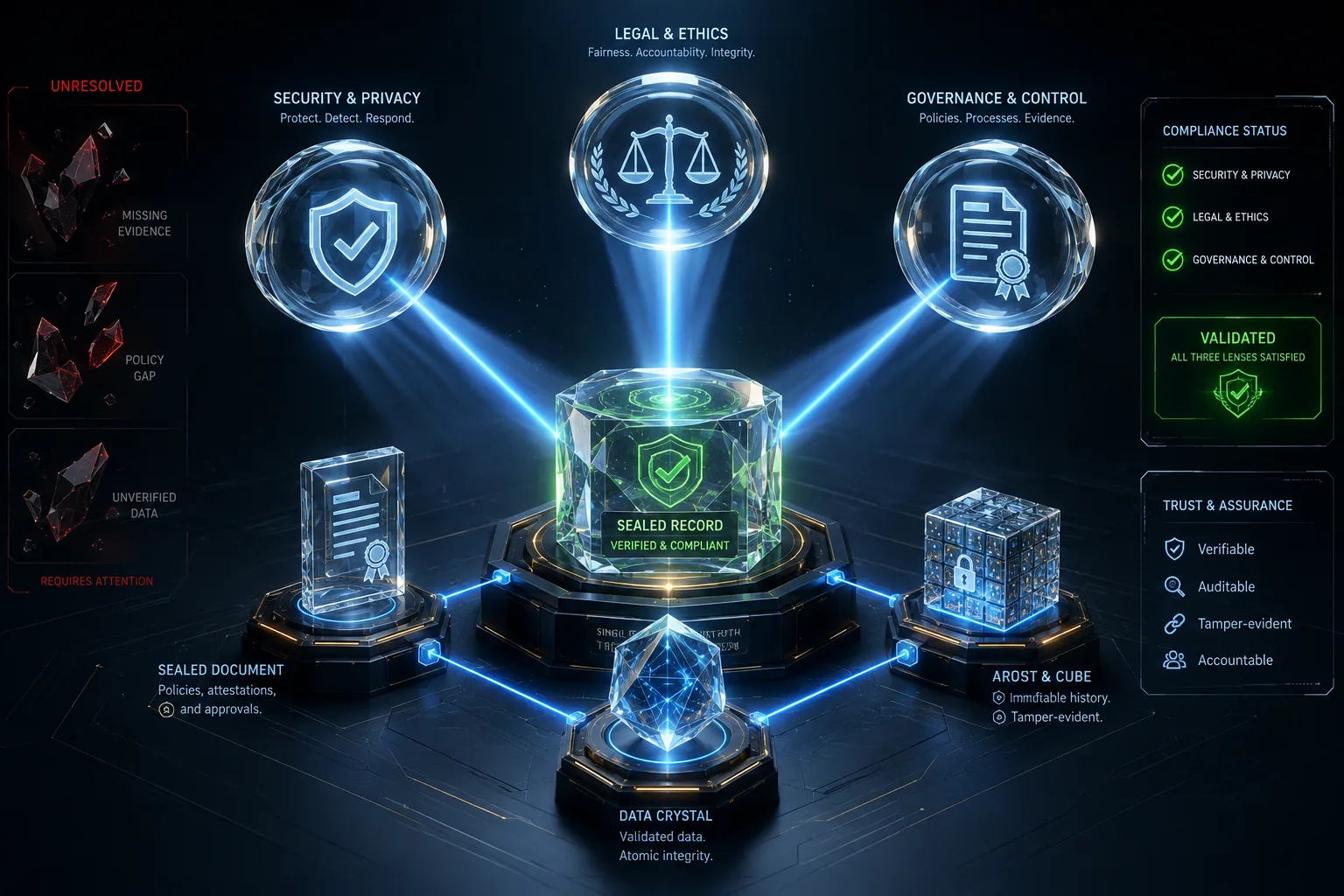
Defensible AI decisions are decisions backed by records that withstand third-party scrutiny — from regulators under the EU AI Act, from assessors using the voluntary NIST AI RMF, and from auditors checking ISO/IEC 42001 readiness. Traceability reconstructs what an AI agent did; defensibility adds why the decision was justified, who exercised oversight, and cryptographic proof that the record was not altered. The core artifacts are the Decision Record (a self-verifying PDF/A-3B document with the signed machine packet embedded), the signed decision packet (machine-readable JSON with decision summary, context, deliberation, alternatives, evidence references, rationale, impact and human-oversight status), and the evidence package (a per-article folder structure a regulator receives). AIAgentree supports compliance work under all three frameworks; it does not by itself make an organization compliant. This hub guide links to in-depth articles on each artifact and framework.
Logs prove what happened. A defensible decision record proves why it was justified, who oversaw it, and that nobody altered it afterwards. This guide is the map to every artifact in that sentence.
- •Traceability ≠ defensibility — reconstruction is not justification. The positioning piece explains the gap.
- •The Decision Record — a self-verifying PDF an auditor opens, with the signed machine packet embedded. Full walk-through.
- •Three frameworks, one record — EU AI Act obligations, the voluntary NIST AI RMF (all 72 subcategories), and ISO/IEC 42001 readiness (38 Annex A controls).
- •The evidence package — per-article folders a regulator receives, with an honest failure manifest. Folder-by-folder tour.
- •Honest scope — decision records support compliance; they do not, on their own, make you compliant.
Traceability tells you what an agent did. This cluster is about the next step: records that stand up — under the EU AI Act, NIST AI RMF and ISO/IEC 42001.
- 1.Defensible AI Decisions: The Complete Guide to Records an Auditor Can Act OnYou are here
- 2.They Made Agents Traceable. We Make Their Decisions Defensible.
- 3.The Decision Record: the PDF an Auditor Actually Opens
- 4.Inside the Signed Decision Packet (the JSON)
- 5.Inside an EU AI Act Evidence Package (Folder by Folder)
- 6.Human Oversight You Can Prove (Because Machines Can't Hold the Permission)
- 7.Article 86: What Affected Persons Can Demand From Your AI
- 8.From First Trace to Evidence Package: an EU AI Act Flow Walk-Through
- 9.A NIST AI RMF Self-Assessment You Can Actually Finish
- 10.ISO/IEC 42001 Readiness: 38 Controls, One Honest Score
- 11.Agent-Native Onboarding: Tracing in 10 Lines (and Agents Can Sign Themselves Up)
An audit request is never really asking for your logs.
It is asking a harder question: can you justify this decision to someone who does not trust you?
Logs answer what happened. Justification needs reasons, oversight, and proof of integrity — and that is a different artifact.
Disclaimer: This guide is for informational purposes only and does not constitute legal advice. AIAgentree supports compliance work; using it does not by itself make an organization compliant with the EU AI Act, NIST AI RMF or ISO/IEC 42001. Regulation text current as of August 2026 — verify citations before relying on them.
Traceability Is Table Stakes. Defensibility Is the Job.
The 2026 agent-security ecosystem got remarkably good at traceability: identity layers answer who called, agent harnesses record what the agent did, sandboxes enforce what it may do. If you run AI agents in production, you probably have some of this already — and you should. We wrote about that stack, and why it is an input for us rather than competition, in They Made Agents Traceable. We Make Their Decisions Defensible.
But now run the test on your own systems: pick one consequential decision an AI agent made last quarter. Can you produce, today, a single document that states what was decided, the reasons for and against, the alternatives considered, who exercised human oversight — and proves the record has not been edited since?
If the answer is "we'd have to assemble that from logs", you have traceability without defensibility. A trace is raw material. A defensible record is the finished artifact a regulator, a court, or an affected person can act on.
Who Actually Asks for These Records
Defensibility sounds abstract until you list the people who will request the record. There are four, and they want different things:
| Who asks | Under what | What they need |
|---|---|---|
| A market-surveillance regulator | EU AI Act Articles 12, 13, 14 (high-risk systems, in application from December 2, 2027) | An evidence package: logs that enable traceability, interpretable outputs, proof of human oversight |
| An affected person | EU AI Act Article 86 — the right to an explanation of an individual decision | A clear, meaningful explanation of the role the AI played in the decision |
| An internal or external assessor | NIST AI RMF — voluntary, but the de-facto US operating model | Evidence against the 72 subcategories across GOVERN, MAP, MEASURE, MANAGE |
| A certification-track auditor | ISO/IEC 42001 — the AI management system standard | A Statement of Applicability over 38 Annex A controls, each included or excluded with a documented justification |
Note the asymmetry: only the first two are legal obligations, and only in scope-relevant cases. NIST AI RMF is voluntary. ISO/IEC 42001 readiness is preparation for certification, not certification itself — and neither NIST nor ISO alignment makes you EU-compliant. Any vendor blurring those lines is overselling; the frameworks answer different questions and the honest position is to say so.
The Three Artifacts of a Defensible Decision
Everything in this cluster reduces to three artifacts, each with its own deep-dive article.
1. The Decision Record — the PDF an auditor opens
A self-verifying PDF/A-3B document, one per sealed decision: a human-readable account of what was decided and why, the result of tamper-evidence verification run at export time, a signature block, and the machine-readable packet embedded inside the file itself. No portal login, no trust in our storage — the file is the record. The regulatory narrative prose in it is currently a draft pending legal sign-off; the underlying data, signatures and verification are production. Page-by-page walk-through.
2. The signed decision packet — the JSON a machine verifies
The machine half of the record: top-level sections for the decision summary, context, deliberation, alternatives considered, evidence references, rationale, impact assessment, and human-oversight status — cryptographically signed, so a third party can verify it offline against our published keys. Inside the packet.
3. The evidence package — what a regulator receives
A ZIP with per-article folders (data governance, record-keeping, transparency, human oversight, quality management, post-market monitoring), per-decision Decision Records beside their machine packets, technical documentation — and a manifest that lists anything which failed to render rather than silently dropping it. Folder-by-folder tour.
One Record, Three Framework Lenses
The same sealed decisions and evidence serve three different governance regimes — which matters, because running three parallel documentation efforts is how compliance programs die.
- ✓EU AI Act — a legal obligation for high-risk systems. Decision records operationalize the record-keeping, transparency and oversight articles; the flow walk-through follows one decision from first trace to evidence package. Start at the EU AI Act compliance hub for the article-by-article picture.
- ✓NIST AI RMF — voluntary, never a legal obligation, and precisely because of that the best operating model: all 72 subcategories (GOVERN 19, MAP 18, MEASURE 22, MANAGE 13) plus the 12 generative-AI profile risks, with a gap analysis you can actually finish. The self-assessment guide, and the NIST-vs-EU comparison.
- ✓ISO/IEC 42001 — readiness, honestly scored: 38 Annex A controls (A.2–A.10), a Statement of Applicability, and 12 clause-artifact documents. Readiness is not certification, and ISO is not EU compliance — the readiness walk-through keeps both distinctions sharp; the ISO-vs-EU comparison maps the overlap.
The Two Claims That Differentiate a Record
Two more spokes carry the claims that separate a defensible record from a well-organized log archive.
Provable human oversight. Article 14 audits do not ask whether you have an oversight policy; they ask you to prove a human exercised the oversight. Architecture answers that more strongly than policy: machine API keys are refused human-judgment permissions at creation — structurally enforced — so every approval in the trail was necessarily made by a person. Human oversight you can prove.
Agent-native onboarding. Increasingly, the integrator reading your docs is itself an agent. Discovery via a signed agent card, a machine-readable free tier, SDKs on PyPI and npm, and tracing in ten lines of code: the onboarding story, and the underlying concept in What Is Decision Tracing?.
“But We Already Log Everything”
The objection every platform team raises — and it deserves a straight answer, because logging everything is genuinely necessary. It is just not sufficient, for three reasons:
- ✗Logs record mechanics, not justification. A log line shows the API call and the output. It does not show the alternatives considered, the arguments for and against, or the reason the decision was defensible at the time it was made.
- ✗Logs are mutable by default. Append-only storage is not tamper-proof. Without tamper-evidence and signatures, a record's integrity rests on “trust our database” — exactly the claim an auditor is paid not to accept.
- ✗Logs cannot prove a human decided. An approval event in a log could have been written by any process with write access. Proving oversight requires the permission structure itself to make machine approval impossible.
Diagnostic question: if a regulator picked one AI-assisted decision from last quarter at random, how many working days would your team need to produce a justification document you would sign? If the answer is more than one, the gap is the artifact, not the effort.
How to Read This Cluster
Ten spokes, each self-contained. A suggested order by role:
Records first, then the flow
Decision Record → Evidence Package Tour → EU AI Act Flow Walk-Through → Article 86.
Packet first, then onboarding
Signed Decision Packet → Agent-Native Onboarding → Traceable vs Defensible.
Frameworks first
NIST AI RMF Self-Assessment → ISO/IEC 42001 Readiness → Human Oversight You Can Prove.
For the platform's plain-language claims and verification pointers, see the brand facts page; for plans and the free tier, see pricing.
Sources & Further Reading
- •Regulation (EU) 2024/1689 (EU AI Act) — full text, EUR-Lex (2024)
- •NIST AI Risk Management Framework 1.0 — NIST (2023), voluntary framework
- •ISO/IEC 42001:2023 — AI management systems standard, ISO (2023)
Frequently Asked Questions
What is a defensible AI decision?
A defensible AI decision is one backed by a record that withstands third-party scrutiny: it states what was decided, the reasoning for and against, the alternatives considered, the evidence relied on, and who exercised human oversight — and it carries cryptographic proof that the record has not been altered since the decision was sealed. Traceability reconstructs events; defensibility justifies them.
How is defensibility different from AI traceability or observability?
Observability shows what an AI system is doing now; traceability reconstructs the sequence afterwards. Defensibility adds the normative layer: why the decision was justified, who approved it, and integrity proof an independent reviewer can verify. The identity, harness and sandbox layers of the agent-security stack produce traces; a defensibility layer turns decisions into records that stand up to audit.
Does using decision records make my organization EU AI Act compliant?
No single tool makes you compliant. Decision records operationalize specific obligations — record-keeping (Article 12), transparency (Article 13), human oversight (Article 14), and individual explanations (Article 86) — but compliance also depends on your risk classification, processes, and organizational measures. AIAgentree supports compliance work; the claim stops there, deliberately.
Is the NIST AI RMF mandatory?
No. The NIST AI Risk Management Framework is a voluntary framework — it is not a legal obligation anywhere. Many organizations adopt it as their internal operating model for AI governance because it is comprehensive (72 subcategories across four functions) and maps well onto binding regimes like the EU AI Act.
Does ISO/IEC 42001 readiness mean my organization is certified?
No. Readiness means your AI management system evidence — a Statement of Applicability over the 38 Annex A controls, clause artifacts, and honest scoring — is prepared for a certification audit. Certification itself is issued only by an accredited certification body after its own audit. And ISO/IEC 42001 conformity is not the same thing as EU AI Act compliance; they are related but distinct.
What artifacts should I be able to produce for an AI audit?
Three: a per-decision Decision Record (a self-verifying PDF with the signed machine packet embedded), the signed decision packet itself (machine-readable JSON covering decision summary, context, deliberation, alternatives, evidence references, rationale, impact and oversight status), and an evidence package (per-article folders with per-decision records, technical documentation, and an honest manifest of anything that failed to render).
Who can request an explanation of an AI decision under the EU AI Act?
Under Article 86, a person affected by a decision taken on the basis of output from a high-risk AI system — where the decision produces legal or similarly significant effects — has the right to obtain a clear and meaningful explanation of the role the AI system played. This is an individual right, not an internal reporting duty, which is why per-decision records matter.
Related Topics
The Defensible AI Cluster
The Decision Record: the PDF an Auditor Actually Opens
Page by page through a self-verifying Decision Record — narrative, tamper-evidence result, signature block, embedded packet.
They Made Agents Traceable. We Make Their Decisions Defensible.
The 2026 agent-security stack answers who, what, may and where-from. None of it answers why a decision was defensible.
Inside an EU AI Act Evidence Package (Folder by Folder)
What a regulator receives: per-article folders, per-decision records, and an honest failure manifest.
Human Oversight You Can Prove
Machines can't hold the permission — so every approval in the trail was necessarily human.
AIAgentree Team
AI Governance
The AIAgentree team is building decision tracing infrastructure for AI agents. Our mission is to make AI reasoning visible, auditable, and improvable.
Pick one decision. Test its defensibility.
Book a 30-minute walkthrough: we take one real decision flow and show you the Decision Record, the signed packet, and the evidence package it would produce.
Book a Walkthrough