
NIST AI RMF Self-Assessment Walkthrough: 72 Subcategories, 12 GenAI Risks
The NIST AI Risk Management Framework (AI RMF 1.0, 2023) is a voluntary framework — never a legal obligation — organized into four functions: GOVERN (19 subcategories), MAP (18), MEASURE (22), and MANAGE (13), totaling 72 subcategories. The 2024 Generative AI Profile (NIST AI 600-1) adds 12 generative-AI risk categories. A workable self-assessment walks each subcategory with a status, an evidence pointer, and an owner; runs a gap analysis over the results; and repeats on an annual lifecycle. Because the framework is voluntary, it functions best as an internal operating model for AI governance, and it maps well onto binding regimes such as the EU AI Act. AIAgentree implements the assessment as a structured editor over all 72 subcategories with gap analysis and an annual assessment lifecycle; evidence links resolve to sealed decision traces. Supporting an assessment is not certification, and NIST alignment is not EU AI Act compliance.
The NIST AI RMF is voluntary — and that is its strength: it is the best available operating model for AI governance. The assessment is finishable if you treat it as 72 rows with status, evidence, and owner, not 72 essays.
- •Four functions — GOVERN (19), MAP (18), MEASURE (22), MANAGE (13): 72 subcategories total.
- •GenAI profile — 12 additional generative-AI risk categories from NIST AI 600-1 (2024).
- •Finishable format — per subcategory: status, evidence pointer, owner. Nothing else.
- •Lifecycle, not event — a gap analysis feeds an annual re-assessment; the delta is the progress report.
Traceability tells you what an agent did. This cluster is about the next step: records that stand up — under the EU AI Act, NIST AI RMF and ISO/IEC 42001.
- 1.Defensible AI Decisions: The Complete Guide to Records an Auditor Can Act On
- 2.They Made Agents Traceable. We Make Their Decisions Defensible.
- 3.The Decision Record: the PDF an Auditor Actually Opens
- 4.Inside the Signed Decision Packet (the JSON)
- 5.Inside an EU AI Act Evidence Package (Folder by Folder)
- 6.Human Oversight You Can Prove (Because Machines Can't Hold the Permission)
- 7.Article 86: What Affected Persons Can Demand From Your AI
- 8.From First Trace to Evidence Package: an EU AI Act Flow Walk-Through
- 9.A NIST AI RMF Self-Assessment You Can Actually FinishYou are here
- 10.ISO/IEC 42001 Readiness: 38 Controls, One Honest Score
- 11.Agent-Native Onboarding: Tracing in 10 Lines (and Agents Can Sign Themselves Up)
Somewhere in your organization there is a spreadsheet titled something like AI_RMF_assessment_v3_FINAL.
It has 72 rows. About 30 are filled in. Nobody has opened it since the quarter it was created.
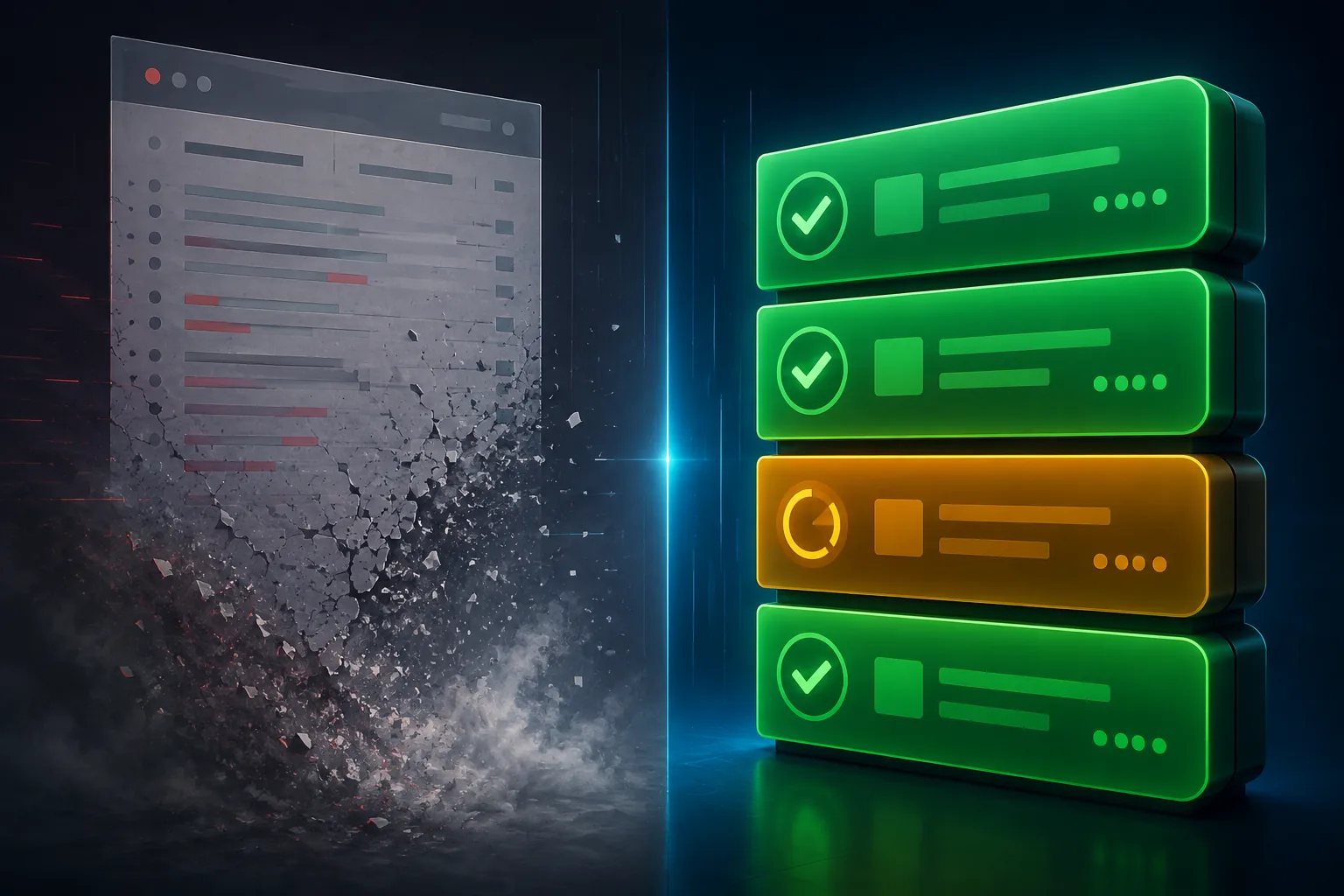
The problem is not your team. It is the format. Assessments finish when rows are cheap.
Voluntary Is Not a Weakness — It Is the Point
First, the claim that gets misstated most: the NIST AI Risk Management Framework is voluntary. It is not a law, not a regulation, and no market-surveillance authority will ever fine you against it. If a vendor implies otherwise, close the tab.
But voluntary is precisely why it works as an operating model. Binding regimes like the EU AI Act tell you what outcomes you owe and when; they do not tell you how to run AI risk management day to day. The RMF does: it decomposes "govern AI responsibly" into 72 concrete, checkable subcategories across four functions. Organizations that adopt it get a shared vocabulary, a complete checklist, and a structure that maps cleanly onto the binding regimes when those arrive — the mapping we detail in NIST AI RMF vs EU AI Act.
So the honest framing for your board: we assess against NIST because we choose to run governance seriously, not because anyone makes us. That sentence, backed by a finished assessment, is worth more than any compliance badge.
The Four Functions, and What Each One Is Really Asking
The RMF's core is four functions, subdivided into categories and then subcategories — 72 in all. Each function has a distinct center of gravity:
| Function | Subcategories | The real question |
|---|---|---|
| GOVERN | 19 | Do policies, roles, and accountability structures for AI risk actually exist — and does anyone own them? |
| MAP | 18 | Do you know what AI systems you run, in what context, with what intended purpose and what potential impacts? |
| MEASURE | 22 | Are the risks you mapped actually being measured — with metrics, evaluations, and tracking that would notice a change? |
| MANAGE | 13 | When measurement finds something, does anything happen — prioritization, response, monitoring, incident handling? |
Notice the dependency chain: MEASURE is meaningless over systems you never MAPped, and MANAGE is theater without MEASURE feeding it. This is why assessments that start alphabetically stall — GOVERN's 19 subcategories are the most organizational and the least satisfying to a technical team. If your assessment keeps dying, start with MAP for one system, and let the concreteness pull the rest along.
The 12 GenAI-Profile Risks
The 2024 Generative AI Profile (NIST AI 600-1) extends the framework with twelve risk categories specific to generative systems — the list runs from confabulation and dangerous-content generation through data privacy, information integrity, and value-chain risks. If your AI estate includes LLM-based agents, the profile is not optional reading: it is the part of the framework written about the systems you actually run.
Treat the twelve as a second checklist that cross-cuts the 72 subcategories: for each profile risk, your MAP rows say where it can occur, MEASURE rows say how you would notice, MANAGE rows say what you would do. Agent-specific governance questions — autonomy, delegation, tool use — get their conceptual treatment in What Is AI Governance?.
The Format That Finishes: Status, Evidence, Owner
Here is the whole method. For every one of the 72 subcategories, you record exactly three things — and resist recording more:
One of four values
Implemented / Partial / Not implemented / Not applicable (with a one-line justification for N/A). No prose paragraphs, no maturity poetry.
A pointer, not a description
A link to the artifact that proves the status: the policy, the eval report, the monitoring dashboard — or, for decision-level subcategories, the sealed decision traces themselves.
A name, not a team
The person who answers for this row at the next assessment. Unowned rows are how a 72-row assessment becomes a 30-row one.
A filled row then reads like: MEASURE — decision traceability: Implemented. Evidence: sealed traces with signed packets for all production credit decisions. Owner: J. Weber. Fifteen seconds to read, checkable, and — because the evidence is a pointer to a live artifact rather than a claim — the row cannot silently rot. This is exactly how AIAgentree's assessment editor structures it: all 72 subcategories, status and evidence per row, with evidence links resolving to real traces.
Gap Analysis and the Annual Lifecycle
A finished pass is not the end state — it is the input. The gap analysis is mechanical once the rows exist: every Partial or Not-implemented row with a non-trivial risk behind it becomes a backlog item with the row's owner attached. No workshop required; the assessment is the workshop.
Then the lifecycle: re-assess annually (or after material changes — a new high-risk use case, a major model swap). The second pass is dramatically cheaper than the first, because unchanged rows carry forward with their evidence re-checked, and the delta — which rows moved, which regressed — is itself the governance progress report your leadership actually wants to read.
Diagnostic question: if you ran the 72 rows today, how many could cite evidence that exists as a live artifact — and how many would cite a document last touched the week it was written?
"Isn't a Voluntary Assessment Just Paperwork?"
It is — if the evidence column points at documents. That is the failure mode of every framework, not a flaw in this one: an assessment over claims decays the day it is finished.
The fix is to make the evidence column point at records the systems produce anyway. If your agents emit sealed decision traces as they run, then the traceability, transparency and oversight rows cite living evidence — the same records that serve EU AI Act obligations and ISO/IEC 42001 readiness. One record stream, three framework lenses; the assessment stops being paperwork the moment its evidence is exhaust from production.
Sources & Further Reading
- •NIST AI Risk Management Framework 1.0 — NIST (January 2023)
- •NIST AI 600-1 — Generative AI Profile — NIST (July 2024)
- •NIST AI RMF Playbook — suggested actions per subcategory, NIST
Frequently Asked Questions
Is the NIST AI RMF mandatory?
No. The NIST AI Risk Management Framework is a voluntary framework — it is not a law or regulation, and no authority enforces it. Organizations adopt it by choice as an operating model for AI governance, often because its structure maps well onto binding regimes like the EU AI Act.
How many subcategories does the NIST AI RMF have?
72, organized under four functions: GOVERN has 19 subcategories, MAP has 18, MEASURE has 22, and MANAGE has 13. Each subcategory is a concrete, checkable statement about your AI risk-management practice, which is what makes a row-based self-assessment feasible.
What is the NIST Generative AI Profile?
NIST AI 600-1, published in July 2024, is a cross-sectoral profile of the AI RMF for generative AI. It identifies 12 risk categories specific or amplified in generative systems — such as confabulation, information integrity, data privacy, and value-chain risks — and suggests actions mapped back to the framework's subcategories.
How long does a NIST AI RMF self-assessment take?
With the row-based format — status, evidence pointer, owner per subcategory, no essays — a first full pass over one AI system typically fits into weeks, not quarters, with the time dominated by locating evidence rather than writing. Annual re-assessments are much faster because unchanged rows carry forward and only the delta needs attention.
Does completing a NIST AI RMF assessment make my organization EU AI Act compliant?
No. The RMF is voluntary and the EU AI Act is binding law; alignment with one is not compliance with the other. The overlap is real — traceability, transparency, oversight and risk management appear in both — so evidence collected for the RMF assessment substantially supports EU AI Act work, but the legal obligations must be met on their own terms.
How does AIAgentree support NIST AI RMF assessments?
With a structured assessment over all 72 subcategories — status and evidence per row, a gap analysis over the results, and an annual assessment lifecycle — plus the 12 GenAI-profile risks. Where a subcategory concerns decision traceability, transparency or oversight, the evidence links resolve to sealed decision traces and signed packets produced by your agents in production, so the assessment cites living records rather than documents.
Related Topics
Related Articles
AIAgentree Team
AI Governance
The AIAgentree team is building decision tracing infrastructure for AI agents. Our mission is to make AI reasoning visible, auditable, and improvable.
Finish the assessment this quarter.
Book a 30-minute session: we walk your team through the 72-row format and show how evidence links resolve to live decision traces instead of stale documents.
See the Assessment Editor